
Quick answer
Task mining records desktop activity, application interactions, task sequences and time per task, to show how work is actually executed rather than how it is documented. It answers a different question from process mining: process mining reconstructs what happened inside enterprise systems, task mining captures what people did between them.
Use task mining when the cost sits in manual desktop work: data entry, copying between applications, email handling and spreadsheet steps. Use process mining when you need cross-system flow analysis. Use a platform that correlates both when you need to know why a system-level bottleneck exists, because the answer is usually in the desktop work between transactions.
Key takeaways
- Task mining captures desktop activity. It records how employees use applications, then applies AI to surface patterns, bottlenecks and automation candidates.
- Task mining is not the same as process mining. Process mining reads system event logs from ERP and CRM. Task mining captures user-level activity. Modern-day process intelligence solutions like KYP.ai combine the best of both.
- The market is sizable and growing. According to Forrester, 74% of enterprises currently use task mining solutions. Market is projected to grow from €2 billion to €10 billion by 2033 (Deloitte).
- The leading task mining solutions in 2026are UiPath Task Mining and Automation Anywhere for RPA-led discovery, Celonis Task Mining for ERP correlation, Microsoft Power Automate Process Advisor for Microsoft estates, and KYP.ai for continuous activity-based intelligence with ROI quantification.
- Customer outcomes are measurable. With KYP.ai, Alorica delivered 952% ROI, $2.5M annual savings and 26% automation potential. Hollard saved 307 hours per month on a single insurance process. Allied Global achieved 3.0x ROI within 90 days across 5,999 employees.
Our simple definition of task mining
Task mining is software that automatically captures and analyzes how employees interact with applications during their daily work. It records digital work interactions, things like application transitions, system actions and on-screen activity, then applies AI to reveal where time is spent, where workflows break down and which tasks are candidates for automation. Task mining is one component of a broader category called process intelligence. On its own, task mining shows what individual users do at their workstation. Combined with process mining (which reads system event logs) and AI (which turns observation into prioritized recommendations), it forms the data foundation that enterprises use to optimize operations and deploy AI agents at scale. The category is growing fast. According to Deloitte’s analysis “Task mining: more than an add-on to process mining,” the task mining market is projected to expand from roughly €2 billion to €10 billion by 2033. Forrester’s Q4 2024 Tech Leader Survey reports that 74% of enterprises are now adopting task mining solutions, with 65% citing process improvement as the top use case. Everest Group named Digital Interaction Intelligence (the analyst-defined evolution of task mining) the fastest-growing segment within the intelligent automation space.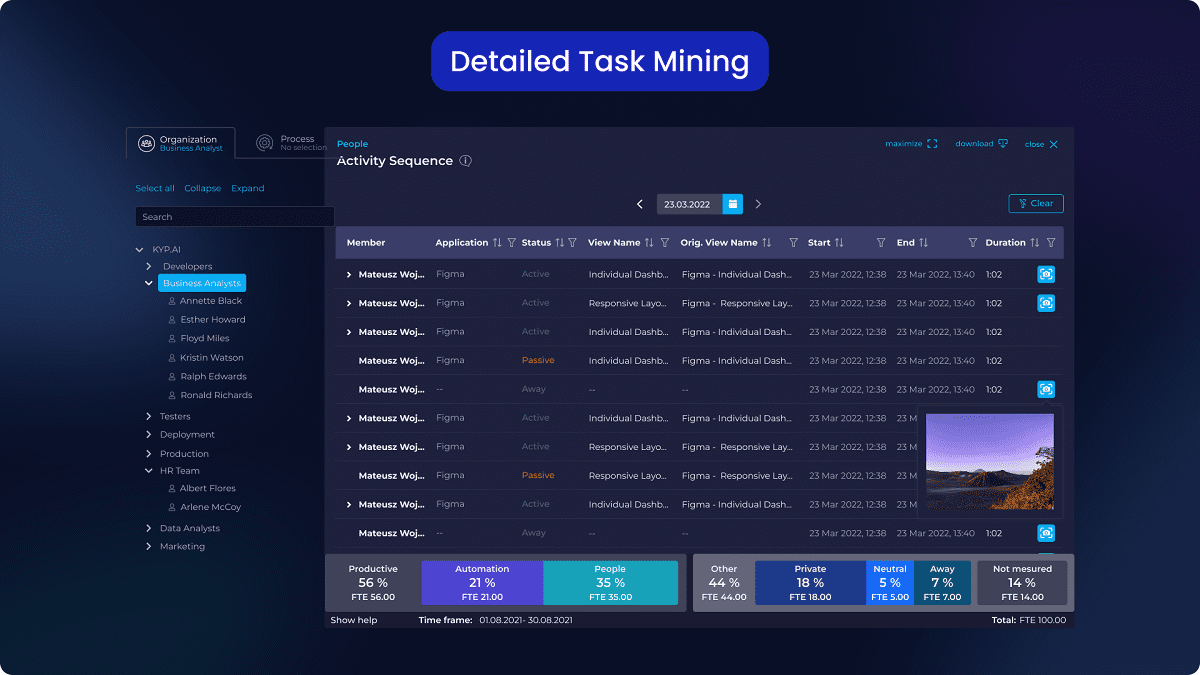
How task mining works
Task mining follows a three-step flow from data capture to actionable insight.Step 1: Data capture
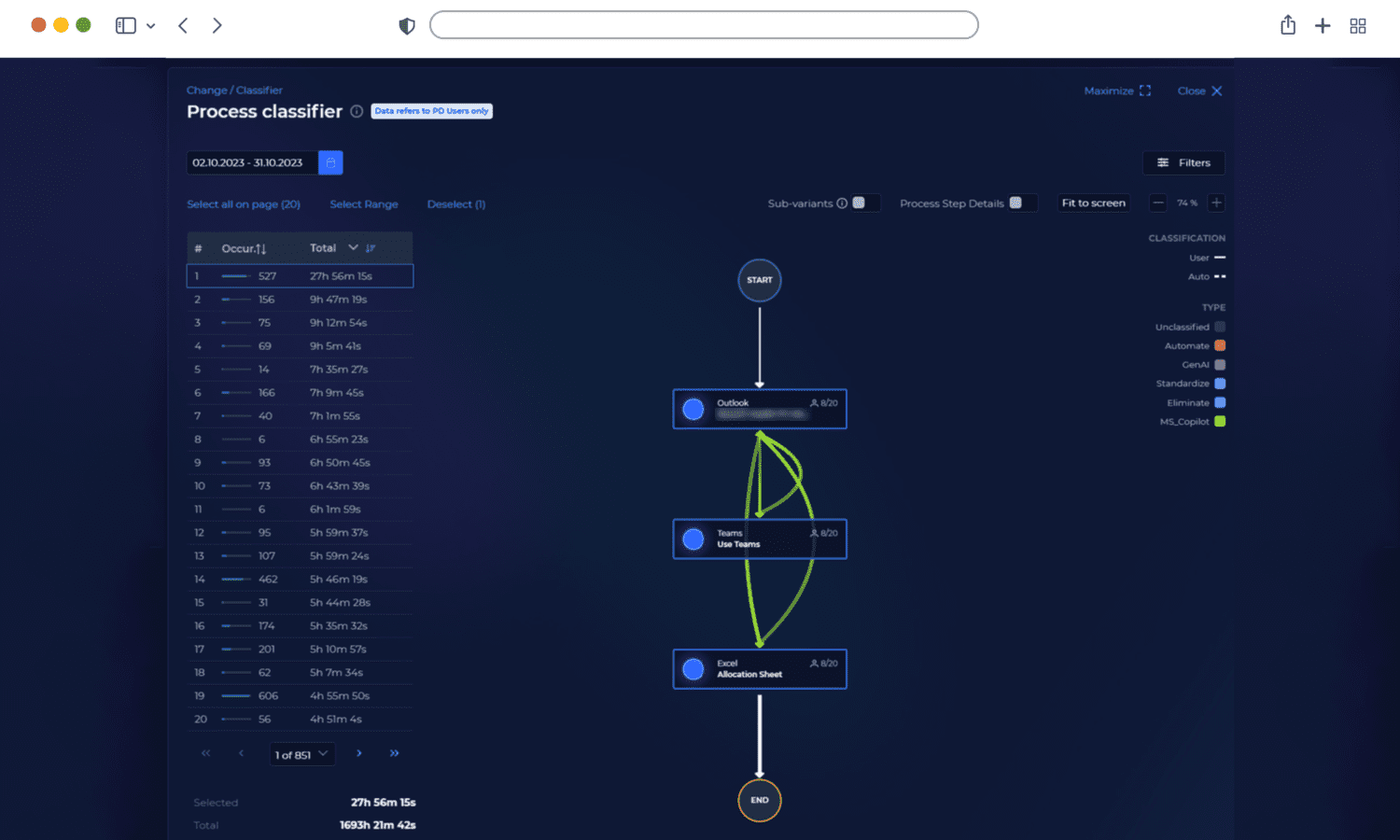
A lightweight software agent runs on employee workstations and records digital work interactions. Modern platforms capture structured event data (application transitions, system actions, business object IDs). Structured event data is more reliable than image-based capture approaches and integrates more naturally with downstream AI and automation pipelines. The best platforms run with under 2% CPU overhead, work across Windows, macOS, Citrix and VDI environments and anonymize sensitive data on-device before transmission. Compliance certifications to look for: GDPR, SOC2 Type II, ISO 27001.Step 2: AI-powered analysis
Captured data is processed by AI and machine learning algorithms that:- Recognize repetitive task sequences suitable for automation.
- Detect process variations and identify high-performer patterns.
- Quantify time spent across activities and applications.
- Map cross-application workflows that touch multiple systems.
- Identify bottlenecks and inefficiencies in real time.
Step 3: Actionable insight generation
Analysis output feeds prioritized recommendations:- Specific tasks ranked by automation potential and ROI.
- Current-state process documentation derived from observed behavior.
- Training needs and skill gaps surfaced by performance variations.
- Conversational AI interfaces that let business users query insights in natural language.
What makes task mining different from other process analysis techniques?
Task mining provides a granular view often missed by traditional process discovery methods. It can accurately pinpoint specific steps within a process that can be streamlined or automated. It also allows you to analyze processes that happen across different business applications or websites, giving you a 360 degree view on how work gets done across business operations. Task mining is not an employee tracking solution. It goes beyond simple time tracking or productivity monitoring. When implemented correctly, it creates a comprehensive digital twin of your operations, revealing the tacit knowledge that exists in how people actually work, and inefficiencies in workflows that can not be captured by conventional process analysis techniques. Increasingly, task mining is becoming an enabler of agentic AI across the enterprise. It can help you map out complete workflows that can be automated using agentic AI platforms or more traditional robotic process automation (RPA) solutions.Task mining vs. process mining: understanding the difference
While both task mining and process mining aim to improve operational efficiency, they approach the challenge from different perspectives:| Aspect | Process Mining | Task Mining |
| Data source | System-level event logs from ERP and CRM applications | User-level interactions across all applications |
| Focus | System-centric view of business processes | Human-technology interaction level |
| Visibility | High-level flow of business processes; limited visibility into user behavior | Granular visibility into how employees actually work |
| What it misses | Human interactions and variations between system touchpoints | End-to-end process flows across systems |
| Best for | Understanding end-to-end process flows and system bottlenecks | Identifying automation opportunities and process inefficiencies |
| Key strength | Shows the high-level flow across enterprise systems | Reveals variations, workarounds, and manual steps |
What task mining reveals that other methods miss
Task mining is the only method that captures the work happening between systems. Three categories of insight come out reliably: Hidden manual work. Spreadsheet workarounds, copy-paste between applications, email handoffs, manual ticketing. The work that drives delay and cost in BPO, GBS and BFSI operations but produces no event log. Process variations. How high-performing employees complete a task versus how struggling employees complete the same task. The performance gap is often a process gap, not a skill gap. Tacit knowledge. The institutional knowledge that experienced employees carry, captured by recording how they actually work. This becomes increasingly valuable as workforces turn over and knowledge transfer becomes a critical operational risk. For a more concrete view of what these reveals enable, see the art of process discovery.The core features of task mining platforms
Implementing task mining delivers measurable benefits across multiple dimensions of organizational performance:Operational efficiency and productivity gains
Task mining identifies repetitive, time-consuming tasks that are prime candidates for automation. By quantifying exactly how much time employees spend on various activities, organizations can make data-driven decisions about where to focus optimization efforts. Alorica, a leading CX transformation partner, achieved $2.5M in annual optimization savings and an 18% boost in overall productivity by leveraging task mining insights. In one project, they achieved a 30% productivity improvement for an insurance client through continuous monitoring, and in another case identified and eliminated 25% of non-value-added activities for a food delivery app client.Process standardization and performance optimization
Task mining reveals process variations and identifies best practices by analyzing how high-performing employees complete their work compared to others. This visibility enables organizations to standardize workflows based on proven approaches rather than subjective assessments. Hollard Insurance discovered 20% productivity potential by adopting work patterns from peak performers. The platform provided real-time visibility into operations, allowing them to spot variations in workflows and identify improvement areas instantly, saving 307 hours per month through process optimizationBottleneck identification and workflow improvement
By capturing actual work patterns, task mining exposes hidden inefficiencies such as system bottlenecks, excessive wait times, and process steps that create delays. Organizations can pinpoint exactly where workflows break down and implement targeted fixes. Atento identified bottlenecks in a food delivery client’s ticketing system that caused high levels of employee passive time, leading to a potential 35% productivity improvement. For a manufacturing client, they optimized the replacement parts process to be 25% more efficient by incorporating GenAI to streamline cost control and inventory management workflows.Compliance monitoring and process adherence
Task mining continuously monitors how tasks are actually executed and compares them against defined processes and standard operating procedures. This real-time visibility enables early detection of deviations and non-compliance risks, allowing organizations to address issues proactively. Allied Global used KYP.ai to reveal discrepancies between how processes should work and how they actually occurred, providing a clear view that highlighted numerous opportunities for process optimization. This insight contributed to a 25% increase in active productive FTEs and 20 hours saved per month per employee.Knowledge capture and training acceleration
Task mining captures institutional knowledge by documenting exactly how work gets done, preserving critical process expertise before experienced employees retire or transition. This data informs targeted training programs and accelerates onboarding for new team members. Mindsprint trained team leaders on managing performance using KYP.ai insights and developed a central team of 30 Functional Business Analysts who use the platform to standardize, optimize, automate, and replicate processes through their SOAR framework. The platform enabled digital value-stream-mapping at scale, delivering insights equivalent to 15 years of manual analysis.Strategic automation prioritization with proven ROI
Perhaps the most strategic benefit is task mining’s ability to distinguish between what CAN be automated and what SHOULD be automated. By combining process data with ROI modeling, organizations prioritize automation investments based on proven business impact rather than technical feasibility alone. Atento identified 20% process improvement opportunities across client operations and achieved a 27% potential improvement in operations management, resulting in reduced operational costs. Unlike tools focused on single solutions like RPA, their approach recommends the most compatible automation solutions for specific business goals, including Agentic AI, process elimination, and GenAI optimizations tailored to client needs.The known limits of standalone task mining
Buyers evaluating task mining tools in 2026 should be honest about what task mining alone cannot do. It does not see end-to-end process flows. Task mining shows individual desktop sessions. Connecting them into a cross-departmental process requires process mining, AI correlation or both. It raises privacy concerns when implemented with screen recording. Some legacy task mining tools capture screenshots and use computer vision to interpret them. This creates privacy exposure that works councils and procurement flag during enterprise rollouts. Modern platforms that capture structured event data instead of screenshots avoid this issue. It generates more data than most teams can act on. Raw task mining output is voluminous. Without ROI prioritization, AI-driven recommendations and conversational interfaces, teams drown in dashboards without a clear next step. It does not, on its own, enable AI agents. AI agents need business context, not just task recordings. Translating observed behavior into executable agent code requires a layer that most standalone task mining tools do not provide. These limits are why the market is shifting toward integrated process intelligence platforms that include task mining as one capability among several.Leading task mining platforms in 2026
With Gartner tracking at least 25 different task mining solutions, selecting the right platform requires understanding each vendor’s unique strengths and ideal use cases. Here’s a comparison of the top solutions in the market (for a comprehensive analysis of leading platforms, visit our detailed comparison guide):| Solution | Key strength | Best for | Primary limitation |
| KYP.ai (Productivity 360) | Agentic Process Intelligence with production-ready AI agent code generation | Organizations seeking rapid deployment, ROI-driven prioritization, and Agentic AI enablement | Smaller customer base compared to established vendors |
| Celonis Task Mining | Integration with market-leading process mining platform | Existing Celonis customers needing desktop-level insights | Windows-centric; non-persistent VDI requires special handling |
| Automation Anywhere | Fast discovery-to-RPA pipeline with auto-generated documentation | Rapid RPA deployment within unified automation platform | Discovery skews toward RPA-ready tasks vs. broader operational analytics |
| Microsoft Power Automate | Native Microsoft 365 integration with familiar governance | Microsoft-centric organizations seeking unified toolchain | Less robust for heterogeneous system landscapes |
| UiPath Task Mining | Closed-loop pipeline with built-in ROI tracking | UiPath customers wanting governed discovery-to-deployment | Limited contextual insights beyond automation opportunities |
Measurable benefits of task mining
The customer outcomes below are drawn from KYP.ai’s named success stories. They illustrate what task mining capabilities deliver when embedded inside an integrated process intelligence platform.Business process outsourcing (BPO)
BPOs use task mining capabilities to win RFPs, prove differentiated value to clients and accelerate the shift from FTE-based to automation-based service delivery. Alorica delivered 952% ROI using KYP.ai, identifying $2.5M in annual savings, 26% automation potential, an 18% productivity increase and 12% reduction in onboarding time. See process intelligence for BPO for the strategic context.Global business services (GBS) and shared services
GBS organizations face existential pressure to prove strategic value relative to outsourcing alternatives. Task mining capabilities standardize processes across geographies and reveal where top-performer patterns can be replicated. SPS used KYP.ai to quantify savings across 8,500 employees in 20 countries: 874 hours per month in customer experience operations, 599 hours per month in Finance, 496 hours per month in HR and 543 hours per month in Supply Chain Management.Insurance and financial services
Insurance operations carry a dual mandate: regulatory compliance plus operational efficiency. Task mining surfaces inefficiencies in claims processing, KYC workflows and policy administration that span multiple systems. Hollard saved 307 hours per month on a single insurance process and identified 20% productivity potential by adopting peak-performer work patterns. See AI-led insurance automation for the industry-specific view.Contact centers and CX operations
Allied Global achieved 3.0x ROI ($3 returned per $1 invested) within 90 days using KYP.ai across 5,999 employees, plus a 15% productivity increase and approximately 20 FTE savings per client account. Atento identified 35% productivity improvement potential and 20% process improvement opportunities across client operations.Performance management and knowledge transfer
Task mining captures institutional knowledge by documenting exactly how work gets done. Mindsprint onboarded 600+ processes across 1,200+ employees with KYP.ai, compressing 15 years of manual analysis into real time. The platform supported a central team of Functional Business Analysts who used insights to standardize, optimize, automate and replicate processes at scale.The evolution to Agentic Process Intelligence
Task mining is rapidly evolving beyond traditional process analysis into a new category: Agentic Process Intelligence. This represents the convergence of task mining with autonomous AI agents, creating a comprehensive platform for enterprise-scale automation.The three pillars of Agentic Process Intelligence
Leading-edge platforms like KYP.ai are pioneering this evolution by building on three core pillars:1. 360° view on the organization
Capturing and correlating data across people, processes, and technology to provide a unified, fact-based view of how work actually gets done. This includes end-to-end task-level process execution, workforce behavior, and system usage—exposing inefficiencies and bottlenecks that traditional approaches miss.2. Business transformation engine
Converting raw data into actionable intelligence by quantifying inefficiencies and calculating automation ROI. This engine prioritizes high-impact automation opportunities aligned with business goals, empowering decision-makers with precise diagnostics that distinguish between what CAN be automated and what SHOULD be automated.3. Agentic AI enabler
Generating structured business context, action details, and production-ready AI agent code. This provides autonomous AI agents with the instructions and environment they need to reliably execute complex workflows at scale, extending beyond browser automation to Windows, MacOS, legacy, and enterprise systems. “Agentic AI success starts with context, ROI-driven prioritization, and ready-to-execute agent code, all delivered by KYP.ai.” – Frank Scheuble, COO and Co-inventor of Agentic Process IntelligenceWhy Agentic AI requires process intelligence
Traditional task mining and process mining fall short of enabling successful Agentic AI deployment because they lack critical components:- Lack of structured business context: AI agents require rich, company-specific, structured business context to operate reliably at enterprise scale—not just process maps or task logs
- No ROI-driven prioritization: Organizations struggle to distinguish automation opportunities that deliver measurable business value from those that are merely technically feasible
- Missing production-ready code: Even when opportunities are identified, enterprises lack the clear objectives, detailed action data, and executable agent code needed to deploy Agentic AI successfully
See what Wil Bielert Chief Digital Officer from Premier Tech has to say about KYP.ai
Integrate task mining with process optimization strategies
Task mining delivers maximum value when integrated into a comprehensive process optimization strategy rather than deployed in isolation.The symbiotic relationship in continuous improvement
Task mining and process optimization work together in a continuous feedback loop:- Discovery: Task mining reveals granular inefficiencies and automation opportunities
- Prioritization: Business transformation logic identifies high-ROI opportunities aligned with strategic goals
- Implementation: Process optimization initiatives target identified opportunities with precision
- Measurement: Ongoing task mining validates improvements and identifies new opportunities
Optimizing for processes of today and tomorrow
The most strategic implementations address both immediate optimization needs and long-term transformation goals. Task mining provides the real-time operational visibility needed to address today’s inefficiencies while simultaneously building the foundation for autonomous AI agents that will transform tomorrow’s operations. Demonste early ROI. Pilot on a process where the team already suspects friction. Measure baseline performance before deploying. Set a 30-day, 60-day and 90-day check-in. By 90 days, customers should see measurable returns. Alorica’s 952% ROI and Allied Global’s 3.0x ROI in 90 days both followed this pattern.How to overcome implementation challenges in task mining
While task mining delivers substantial benefits, successful implementation requires addressing several common challenges:Manage change and employee concerns
Employee resistance often stems from misunderstanding task mining’s objectives. Key strategies for building acceptance include:- Clearly communicate that the goal is to enhance, not replace, human work
- Involve employees in the process from the start, gathering their input on pain points
- Demonstrate early wins that make employees’ jobs easier and more satisfying
- Provide transparency about what data is collected and how it will be used
Ensure data privacy and compliance
Addressing data privacy concerns as part of your implementation roadmap:- Establish clear policies on data collection, usage, and retention
- Ensure compliance with regulations such as GDPR, CCPA, and industry-specific requirements
- Implement robust anonymization and data masking capabilities
- Work with legal and compliance teams to address any concerns proactively
Enable technical integration
Technical challenges, particularly with legacy systems, can be addressed through:- Close collaboration between IT teams and solution providers
- Phased rollouts that allow for testing and refinement
- Comprehensive training and ongoing support for users
- Selected solutions with proven integration capabilities and lightweight deployment requirements
Bottom line on task mining in 2026
Task mining is no longer a category buyers shop for in isolation. It is one capability inside a broader process intelligence platform that combines task mining, process mining and AI. The buyers winning with this technology in 2026 are not asking “which is the best standalone task mining tool.” They are asking “which process intelligence platform gives me the desktop visibility, system-level visibility, AI prioritization and agentic AI enablement we need to transform operations and scale autonomous agents.” The Deloitte projection ($2 billion to €10 billion by 2033) reflects this shift. The 74% adoption rate Forrester documents is being driven by enterprises that need to see their actual operations, not the documented version. The Everest Group recognition of Digital Interaction Intelligence as the fastest-growing intelligent automation segment reflects analyst consensus that the standalone task mining category is being absorbed into something larger. For organizations evaluating task mining in 2026: the question is no longer whether to capture desktop activity but how to capture it inside a platform that turns that capture into measurable business outcomes and agentic AI readiness. Book a demo with KYP.ai to see what integrated process intelligence looks like in practice.Process mining reads event logs from enterprise systems (ERP, CRM, ticketing). It reveals what happened inside those systems. Task mining captures user-level interactions at the desktop. It reveals how employees actually do the work. Modern-day process intelligence platforms like KYP.ai combine the best elements of both with AI to produce end-to-end visibility.
Modern task mining agents deploy in days with minimal IT involvement. With KYP.ai live insights typically arrive within seconds of capture, statistically relevant process baselines within three weeks and measurable ROI within 90 days. System-log-based platforms typically require months of data engineering before the first production insight.
Organizations using KYP.ai have reported measurable returns inside 90 days. Documented outcomes include Alorica’s 952% ROI ($2.5M annual savings, 26% automation potential, 18% productivity gain) and Allied Global’s 3.0x ROI within 90 days across 5,999 employees. Use our ROI calculator for a custom estimate.
If your processes execute entirely within ERP, CRM and ticketing systems, process mining alone may suffice. If significant work happens in email, Excel, SaaS tools, legacy applications or any desktop workflow that produces no event logs, you need task mining capabilities to see the complete picture. In practice, most enterprises require both, which is why integrated process intelligence platforms like KYP.ai are the dominant approach in 2026.
Task mining provides the observed-behavior data that AI agents need to operate reliably at enterprise scale. Standalone task mining typically stops at recommendations. Integrated platforms like KYP.ai go further and generate production-ready agent code deployable on UiPath Studio, SAP Joule and Microsoft Copilot Studio. See agentic AI and process intelligence.
Get your process intelligence with the ROI attached - Book a demo!
Book Demo

 Wojciech Zytkowiak-Wenzel
 Szymon Kozak

 Adam Bujak
 Felix Haeser



 Mariusz Mroz