
How Atos Scaled an ROI-Backed Agentic AI Programme on a Foundation of Operational Truth
Twelve months into its own AI transformation programme, Atos had six workstreams, a thousand-use-case portfolio and the governance to manage them. The next challenge was scale: validating value continuously, across every function, with operational evidence. KYP.ai process intelligence supplied that layer.
-
25% FTE productivity opportunity, Purchasing - in delivery
-
22% handling time variance, location A vs B
-
40% purchasing time: low-risk, high-volume PR processing

The Opportunity: Operational Truth
In 2025, Atos launched a comprehensive AI Transformation Programme internally, running the programme on the same principles it recommends to clients. The scope was significant: six workstreams covering Leadership and AI Strategy, AI Literacy and Talent, Platform Architecture, Responsible AI and Risk, Value Realisation and ROI, and Change Leadership. The ambition was to develop valuable use cases across all business functions – from Finance and Procurement through to HR, Legal, Sales, and R&D.
The governance was in place. The use case intake was in place. The AI literacy programme was running. The platform was being built.
Industrialising Value Validation
As the portfolio grew past 1,000 opportunities, the programme needed to industrialise how value was validated, so the strongest use cases could move from pilot to production with confidence.
Anchoring Business Cases in Data
Business cases drew on structured assessment and stakeholder input. To underwrite investment decisions at portfolio scale, they needed to be anchored continuously to real operational data.
Closing the Visibility Gap
Leadership sees 10% of actual work. The real opportunity sits in the other 90%: re-keyed data, abandoned tasks, undocumented workarounds, duplicate work, and approval loops with no owner.

The Solution: The foundation for investment-grade ROI
KYP.ai was deployed as the Process Intelligence layer of the Atos AI Transformation Programme. The objective was precise: anchor every business case in evidence derived from how work is really performed – continuously, in real time, from the people doing it.
-
An Official Atos Scaler Partner KYP.ai is an official Atos Scaler Open Innovation partner, embedded within the Sovereign Agentic Studio ecosystem. The collaboration is structural, not a one-off project - KYP.ai’s process intelligence sits inside the same ecosystem where Atos builds and scales its agentic AI work.
-
The Partnership Architecture KYP.ai provides the process-intelligence capability within the first stage of a three-stage value chain. KYP.ai delivers the operational truth: real-time 360° view, investment-grade ROI from real data, agent-ready business context. Atos builds, deploys, and monitors agents in live environments, with deep integration into ERP, ITSM, cloud, and legacy estates. Together, the partnership provides investment discipline, governance, and control: KYP.ai shows where the value and risk are; Atos turns that into working agents at scale.
-
What KYP.ai Delivers The KYP.ai platform operates across three pillars. The 360° Enterprise View captures real-time data on people, processes, and technology. The Business Transformation Engine quantifies inefficiencies, calculates where handling time variance and re-work actually live, and produces ROI calculations anchored to real operational data. The Agentic AI Enabler generates production-ready agent code with the business context AI agents need to act reliably at enterprise scale.
The Results: Client Zero: The Purchasing Function
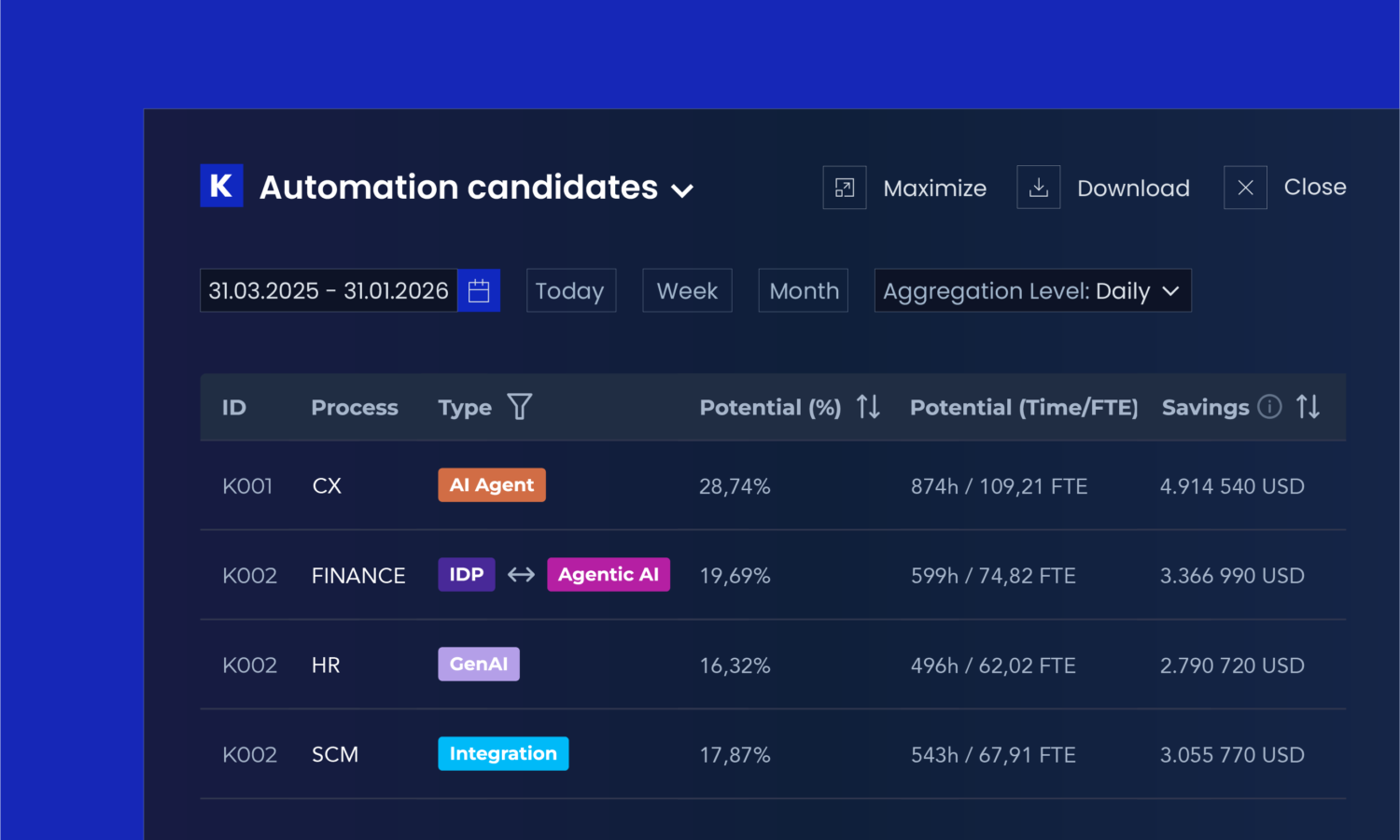
The Atos AI Transformation Programme’s most instructive result came from its own Purchasing function. The deployment followed the diagnostic logic that distinguishes process intelligence from assumption-based analysis: measure first, then act.
Why Purchasing
Purchasing was selected for the first deployment for three reasons. It was high volume and transaction-heavy, so small per-task inefficiencies compounded quickly. It ran across multiple locations with no reliable way to compare performance between them. And it was widely believed to be a strong automation candidate – and the team wanted hard evidence of which parts were worth automating.
What the Data Showed
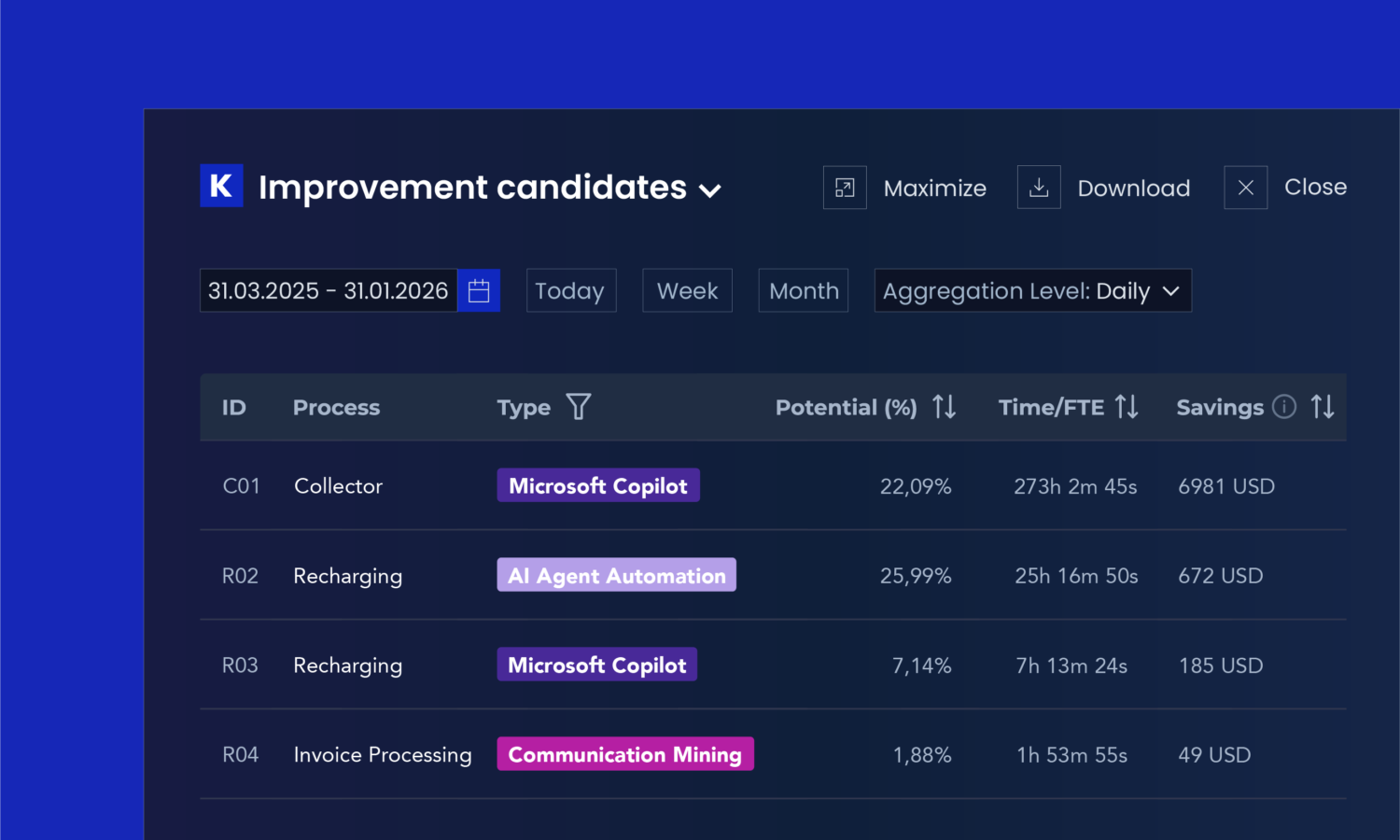
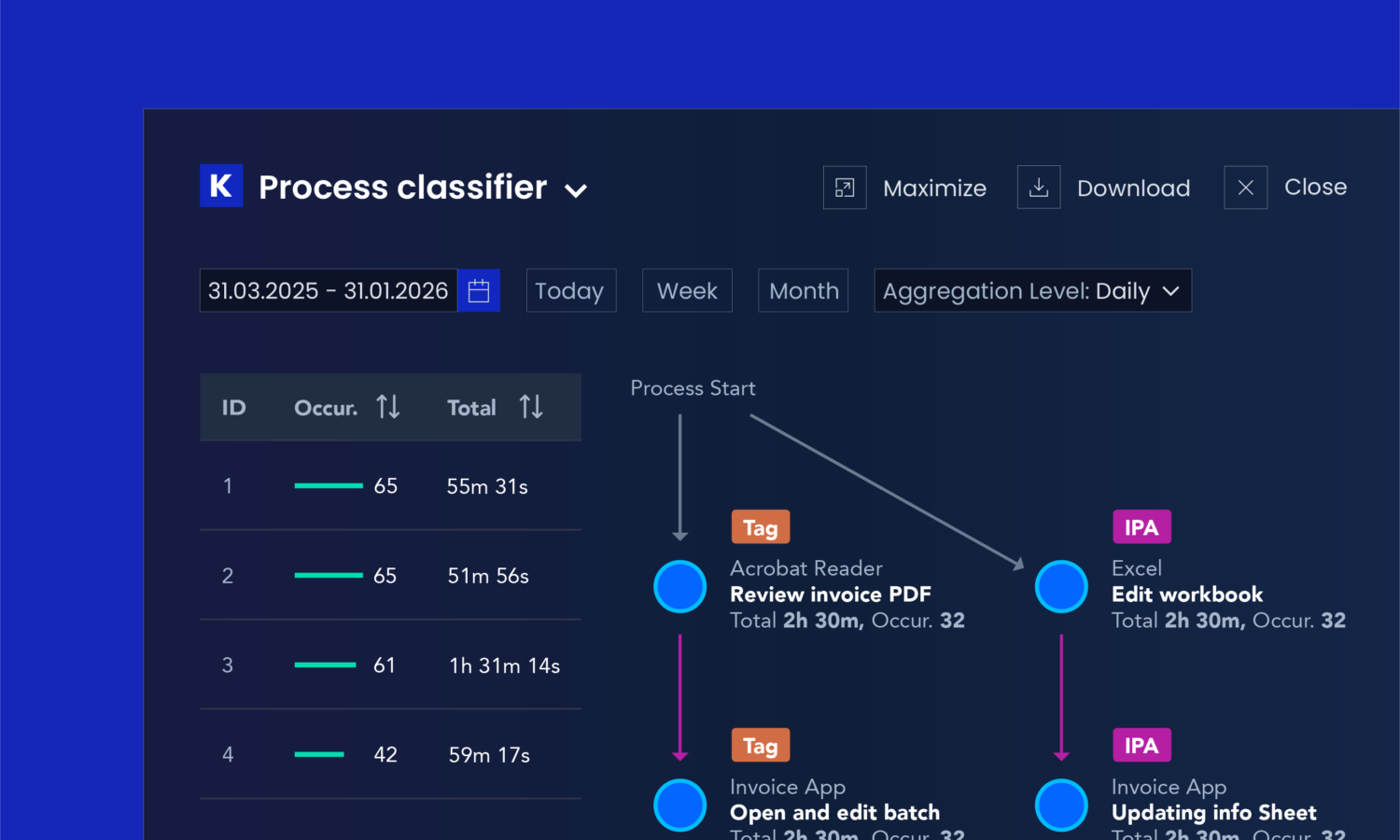
Average handling time in location A was 22% lower versus location B performing comparable work – variance invisible before process intelligence. Distribution analysis separated high-risk, high-spend purchase request processing from low-risk, high-volume approval processing (40% of time). Passive time and re-work patterns were identified, quantified, and mapped to specific process steps.
From Finding to Deployment
The 25% FTE figure is a validated opportunity, not a retrospective claim. Purchase request handling is being standardised across locations so the 22% variance is designed out rather than automated around. Atos is deploying AI agents and RPA against the low-risk, high-volume PR approval path, with intelligent document processing handling the supporting documentation. Value is tracked against the same KYP.ai baseline that produced the business case.
Delivery in Practice: A Governed Path from Visibility to Scaled Execution
The Atos Sovereign Agentic Studio is the industrial execution engine within which KYP.ai operates. It is not a product or a platform – it is the framework that brings together the methods, assets, expertise, governance and delivery capabilities that take an organisation from process visibility through to secure, scalable agent deployment. The three-stage framework moves from understanding how work actually happens through to governing AI agents at enterprise scale.
KYP.ai provides a key process-intelligence capability within the first stage of Atos’s Sovereign Agentic Studio approach. Before any redesign, before any agent is built, before any business case is committed, the team uses process intelligence to establish what the work actually involves. That is the operational truth that makes every subsequent stage defensible.
Understand
Fact-based business case
Map how the process runs with real operational data. Not workshops. Not interviews. Evidence.
Build & Deploy
Enterprise-grade agents
Define tasks to delegate. Build agentic AI employees. Deep integration into ERP, ITSM, cloud, and legacy estates.
Control & Govern
Investment discipline
Link execution to KPIs. Track cost-to-serve. Secure agents with boundaries, testing, and regulatory readiness.

The Two Paths
The AI investment decision comes down to two paths. Path 1: AI pilots multiply, costs creep upward, value is discussed but not proven, governance arrives late. Path 2 starts with operational truth, turns it into quantified ROI, and scales with investment discipline.
Isolated success, no portfolio value. Local optimisation, no enterprise model. Cost without proof.
Pilot Mindset: Pilots Persist

Operational truth > ROI > Investment discipline > P&L. Governed, scalable outcomes at enterprise scale.
Transformation Mindset: P&L Delivered
Within the six workstreams identified in its AI Transformation Programme, Atos built a structured intake mechanism – the AIdea Agent – that takes AI ideas from unstructured concept to scoped use case with value and feasibility assessment. Over 1000 use cases are now in the portfolio across Growth, Finance, HR, Legal, Procurement, Operations, R&D, and Support, at stages from scoped concept through to live deployment. KYP.ai was applied to selected functions – Purchasing first – to establish which of them carried provable value.
The constraint on scaling that pipeline was not idea generation. It was the ability to validate value with enough rigour to make investment decisions. KYP.ai strengthened that capability by providing the operational data needed to move use cases from feasibility hypothesis to investment-grade business case.
The Use Case Pipeline
Key Takeaways
Operational truth is a prerequisite, not a feature
Atos had governance, use case intake – including its own AIdea Agent – and an AI literacy programme in place. Adding continuous operational data helped it underwrite ROI decisions with confidence at portfolio scale. Process intelligence is not an add-on to an AI programme. It is the data layer on which investment-grade AI decisions rest. Any enterprise that cannot answer “where exactly does the value come from?” with operational evidence risks running pilots, not programmes.
You cannot automate what you cannot see
The 90/10 visibility split is a measurable reality. The Purchasing deployment showed 22% handling time variance between locations doing comparable work, and a 60/40 split in effort distribution between high- and low-risk purchase processing types. Neither figure was visible before process intelligence. Automation decisions made without this data optimise for the visible 10% and miss the structural inefficiency underneath.
ROI discipline is what converts a use case portfolio into a P&L line
The Atos programme produced more than 1000 use cases. Converting those into a P&L contribution required evidence strong enough to make ROI defensible to a CFO. That is the role of process intelligence. It does not just identify where automation is possible. It quantifies what fixing it is worth – before the investment decision is made, not after the pilot completes.
What Would Your
Success Story Look Like?
Learn more and book a demo
About KYP.ai
KYP.ai is an agentic process intelligence platform built on three pillars: a 360° View capturing real-time data across your organization's people, processes, and technology; a Business Transformation Engine that quantifies inefficiencies and calculates automation ROI; and an Agentic AI Enabler generating ready-to-execute agent code with structured business context.
Quick Links
© 2026 All Rights Reserved.
You can’t automate what you can’t see. I call it the AI Iceberg. Aim AI at the tip, and 90% of the problem stays frozen below. KYP.ai enables us to understand how the process actually works and decide where to act with evidence. Visibility makes ROI defensible.
Peter Evans VP AI Transformation, Atos